
Quote for this week ..“Gardening is medicine for which you do not need to go to a doctor or have a prescription”.
How true is this? Fresh air, exercise and sunshine.. what more can you need to be happy and healthy?!
Driving the other day I saw a beautifully lily at the exit of a large shopping complex.
There were several and they were amazing on stems that were at least 3 metres long and the flowers actually then extended approximately a further half metre at least.
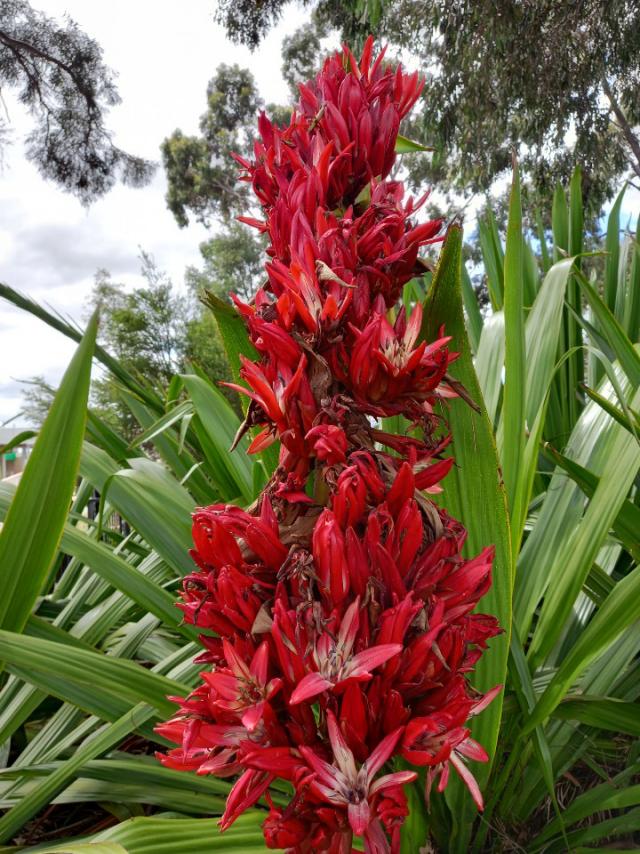
I took the accompanying picture and found that they are a first cousin to the lily I knew as “Gosford Lilies” as a child, but to give them their real name, they are Gymea lilies, Doryanthes excelsa.
This plant has sword like leaves that will be up to about a metre long and then has a tall spike up to 6 metres with a large cluster of bright red flowers on top. Each flower in the cluster can be up to 4 inches across.
I don’t remember them being this tall as a child as I do remember seeing the flowers up close.. maybe I was on a hill above them and looking down?!
The name is from an aboriginal word and a Sydney suburb is named after them.
I have admired them in many places I’ve been over the last weeks while in the Sydney area.
They are blooming beautifully in both the bush and parks and gardens and in nature strips on many of the highways.
The ones pictured however, are giant spear lilies, Doryanthes palmeri, and are growing well out of their native region, in Dubbo N.S.W.!
There are only the 2 types of Doryanthes, Excelsa and Palmeri and while the Gymea lily is found around the central coast of N.S.W, its cousin is found growing on cliffs and rock ledges in semi rainforest from Mt. Warning in N.S.W to Mt. Mistake in Queensland.
Their leaves can be 2 to 3 metres long and the flower spikes tower over them. Unlike their upright cousin, the flowers form along and to the end of the approximately 4 metre stem which tends to bend down rather that be straight up.
The individual red flowers are about 4 inches across.
So the ones I saw are doing extremely well in anything but “semi rainforest” conditions.
Although, with the large amount of rain the area has received this year, maybe it almost qualifies!!
It is listed as being fairly drought tolerant and will take some frost. If grown from seed it may take up to 10 years to flower so not a plant for this impatient gardener even if I had the space!!
Both are certainly spectacular architectural plants to grow where there is plenty of room…but not something for the average town block or home garden!
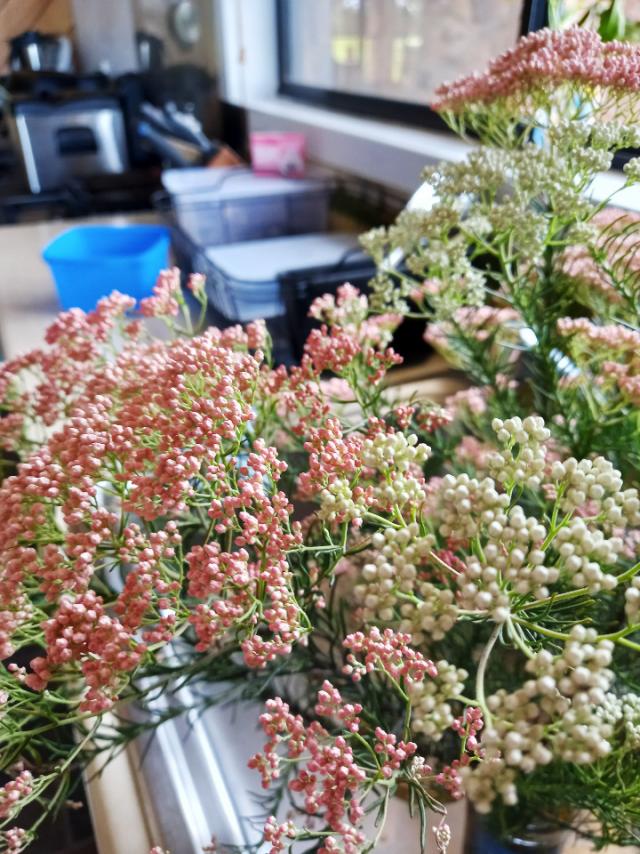
Another native shrub I have seen flowering in my travels, is what is commonly known as rice flower or, if you want to get technical, Ozothamnus diosmifolious.
I am used to seeing the white variety growing wild but have come across a lovely pink one growing in the bush where I have been. Hardy, and can be kept compact if pruned, they would be a lovely addition to a native garden.
Pruning would not be a problem as they are a great cut flower and are used to advantage in flower arranging.
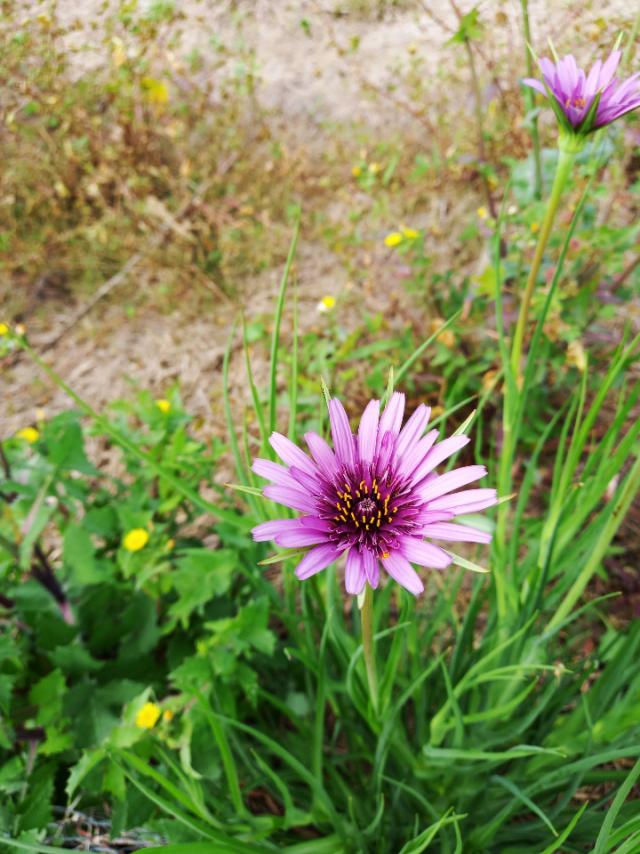
Another interesting flower I’ve seen and that has had me intrigued is a lovely purple daisy. I saw it once in the afternoon as I came up the road and then it wasn’t there the next morning!
Found the plant and then saw it in flower again and took a photo and have now identified it!
Purple salsify.. Tragopogon porrifolious!! Other common names are Oyster plant, noon-flower and purple goats beard.
It has a nice purple daisy like flower, that, but from my observations, only comes early morning and has closed by mid afternoon but has many buds so new flowers each day.
Apparently it is considered a weed in Victoria but is easily controlled.
The stock seem to love it as the surrounding plants are eaten off at ground level!!..
It is native to the Mediterranean area and was cultivated and used by the ancient Romans and Greeks as both a food and medicine.
The root was used commonly as a vegetable in Europe and America until the last century when it lost some of its popularity but even now it is used grated in salads, similar to carrots, for its lovely delicate taste that some liken to oysters.
The root is purported to be one of those “cure all” vegetables. The list of things that it “may” be advantageous for is very lengthy and covers a list of things from digestion to brain health, weight loss and promoting healthy hair growth!!
From what I can learn it is yet another one of those things brought from Europe to Australia as a garden plant and that has now, at least in some areas, become an invasive species.. a pest.. another weed.. a “plant out of place”!
It does however seem to be able to be easily controlled without chemicals, unlike some of the others.. prickly pear, blackberry and St. John’s Wort to name a few.
I hope you all put entries in or went along to St. Mary’s Hall on Wednesday and Thursday to the Spring Flower Show to see what the keen gardeners of Warwick and surrounds had on display.
As I am detained elsewhere, I look forward to a report and seeing some pictures next week!